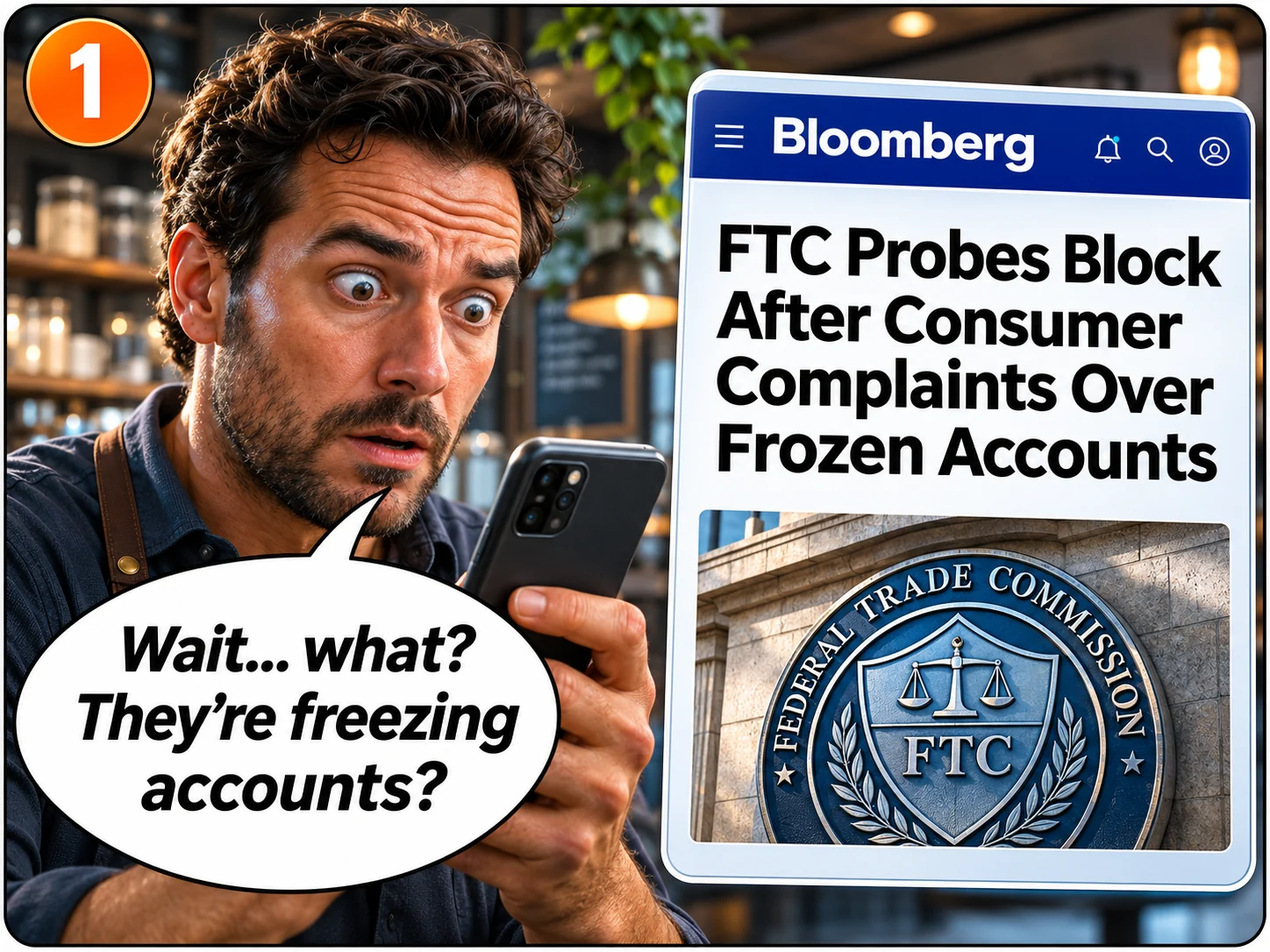
The Discount That Wasn't: Cash Discounts, Surcharges & the $3.99 Mystery

Merchant Marty was trying to tame his processing statement when Delilah Discount swept into Riverside Antiques with emerald velvet, a gold pen, and an irresistible promise: save money without changing the price tags. Then Nora bought a $100 item with her Visa debit card. Her receipt read $103.99. Somewhere in the shadows, Detective Pierce Price reached for his magnifying glass.
Prefer a mystery with masks, theatrical reveals and spectacularly cheesy dialogue? This article is the educational companion to our interactive adventure. We'll explain the real rules without spoiling every twist.
Meet the cast in Delilah's Discount Deception — the full interactive story. The adventure is free to explore.
Act I: The Irresistible Offer
Delilah's presentation was polished enough to make a bookkeeper forget his calculator. Lower processing costs! Increased margins! Simple setup! No irritating shelf-label changes! Marty liked every word. The agreement, unfortunately, had some serious competition for his attention.

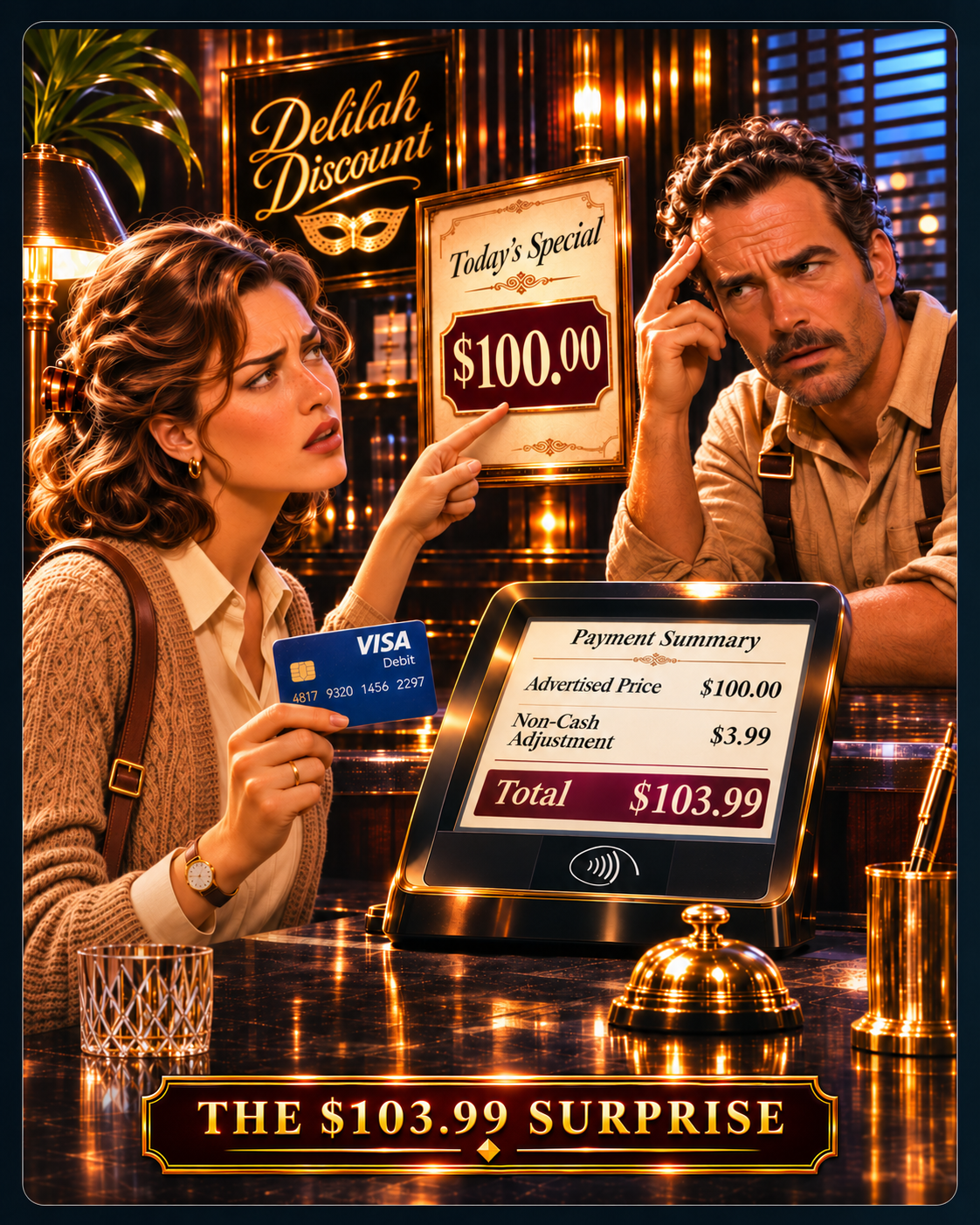
Then a customer named Nora brought a $100 antique to the counter and paid with her Visa debit card. The payment terminal wanted $103.99. Marty explained that he was running a 'cash discount' program. Nora looked from the receipt to the original shelf label, then back at Marty.
| Nora's receipt | Amount |
|---|---|
| Displayed item price | $100.00 |
| Non-Cash Adjustment | +$3.99 |
| Visa debit total | $103.99 |
'If cash earns the discount,' Nora asked, 'why did paying with my debit card ADD a fee to the advertised price?' A perfectly reasonable question. One that the elegant Ms. Discount might have preferred nobody ask.
Act II: The Detective Prefers Receipts
Enter Detective Pierce Price: dark vest, tan trench coat, and an almost supernatural resistance to sales pitches. Pierce didn't ask how persuasive Delilah was. He asked three things: What was advertised? What payment method was used? And what did the customer actually pay?
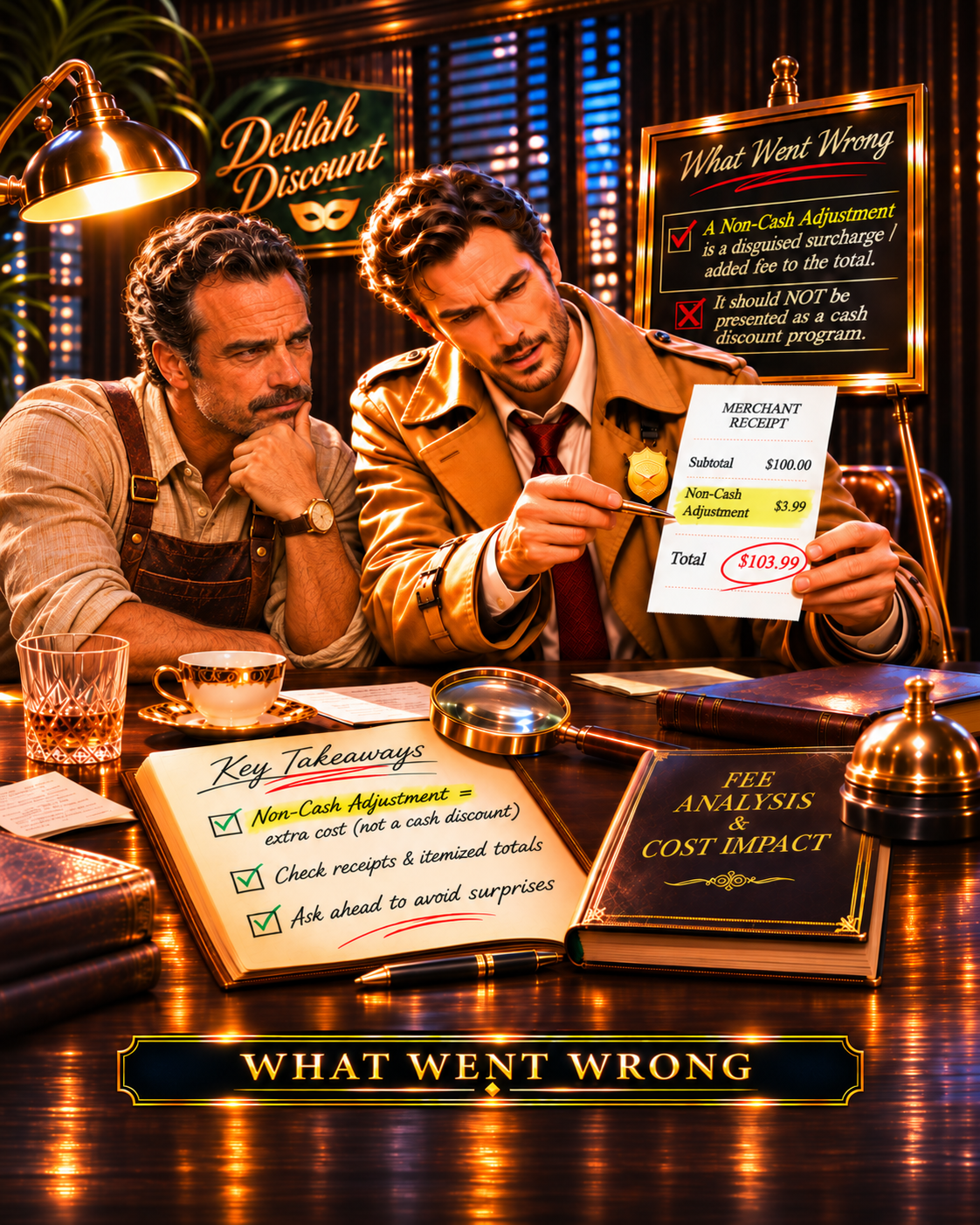
'Marty,' he asked, 'if the item was advertised for $100 and the customer paid $103.99, where exactly was the discount?' Silence. The problem with payment programs isn't that every fee is illegal. It is that several very different programs can sound almost identical when described by a clever salesperson.
Suspect One: Credit-Card Surcharging
A surcharge adds a fee to an eligible credit-card transaction. In many U.S. jurisdictions, credit-card surcharging is permitted with the proper setup, advance notification, customer disclosure and receipt treatment. But the rules have important limits.
- For Visa credit cards, the permitted surcharge is capped at the lesser of the applicable merchant discount rate or 3%. A merchant whose applicable cost is 2.5% cannot simply choose 3%.
- Mastercard publishes a separate maximum cap of 4%, subject to its own cost-of-acceptance formula and other conditions. The Visa 3% ceiling is not a universal limit across every brand.
- Visa and Mastercard prohibit surcharges on their debit and prepaid cards. A debit card does not become a credit card because the customer presses 'credit' on the terminal.
- Merchants must satisfy the relevant network notification, disclosure and receipt requirements, plus applicable state and local laws. Correctly identifying eligible card products is essential.
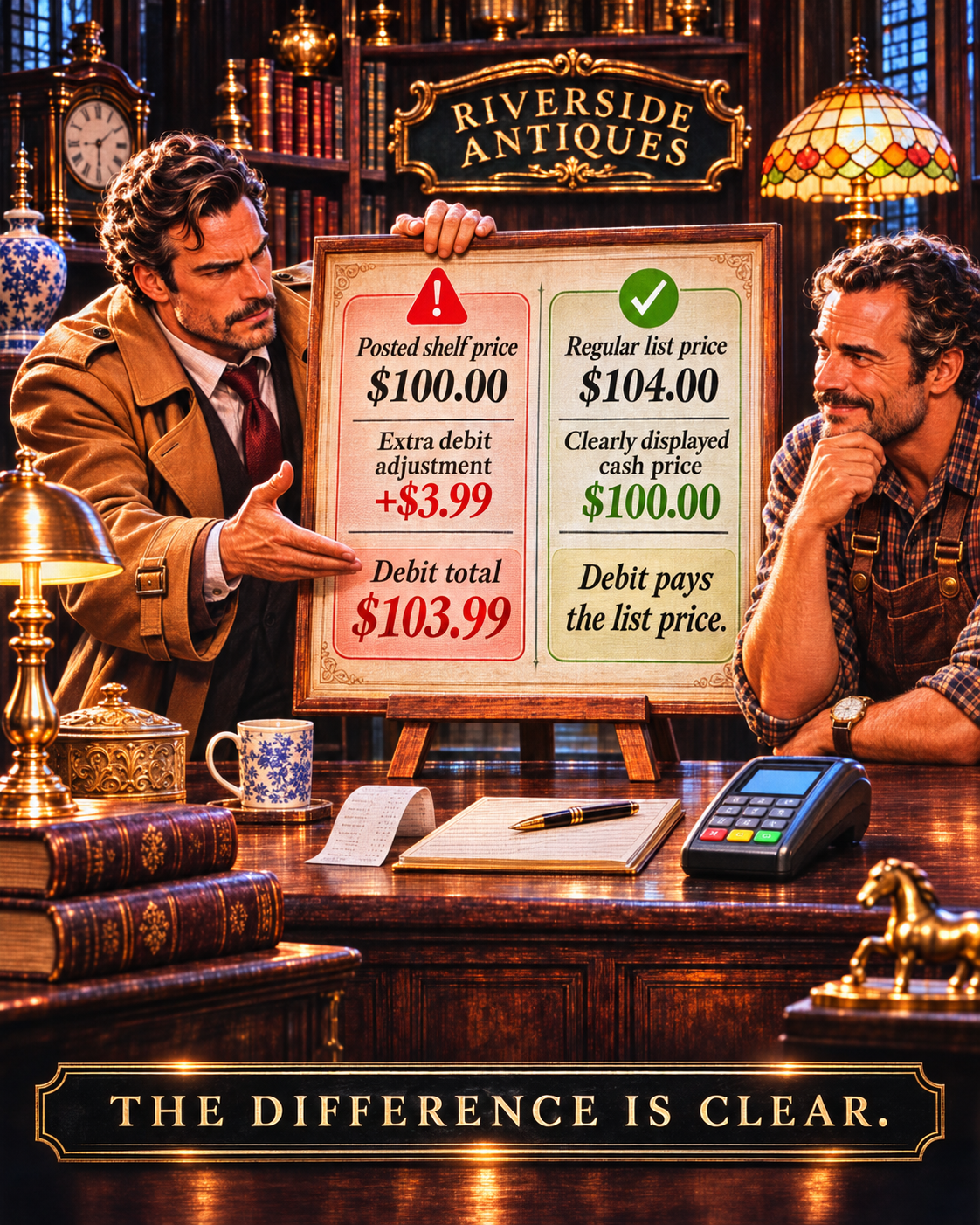
In Marty's example, $3.99 was added to a $100 Visa debit transaction. If that extra amount is a surcharge, the debit-card restriction is a problem. The 3.99% rate would also exceed Visa's 3% percentage cap even on an otherwise eligible Visa credit purchase. Changing the receipt line from 'surcharge' to 'non-cash adjustment' doesn't change the transaction.
A surcharge is defined by what it DOES, not by what the salesperson calls it. Check the posted price, card type, timing of disclosure and final receipt.
Suspect Two: A Genuine Cash Discount
A genuine cash discount goes in the other direction. Rather than displaying $100 and increasing the amount for cardholders, a merchant shows the regular/list price of $104 and lowers it by $4 when a customer pays cash.
| Genuine cash discount example | Amount |
|---|---|
| Regular posted price | $104.00 |
| Cash discount | −$4.00 |
| Cash total | $100.00 |
| Card purchase at the regular price | $104.00 |
Visa's guidance says a proper cash-discount setup must show the card price per item, or both the cash and card price side by side per item. The card total must come from those displayed item prices, not from a new card-use fee invented at checkout.
That is why the seemingly clever 'reverse' approach deserves scrutiny: keep a lower price on all the shelf tags, tack an adjustment onto non-cash payments, then remove it for cash while calling the whole process a discount. Under Visa's guidance, that card-triggered increase may instead be treated as a surcharge.
Act III: The Beautiful Disguise Falls Apart
The emerald mask cracks, the ruby lights come on, and Delilah Discount reveals another name: Scarlett Surcharge. One woman, two names, and one stubborn set of numbers. She can call the extra amount a 'non-cash adjustment,' 'processing offset,' or 'service fee.' The receipt still says $103.99.
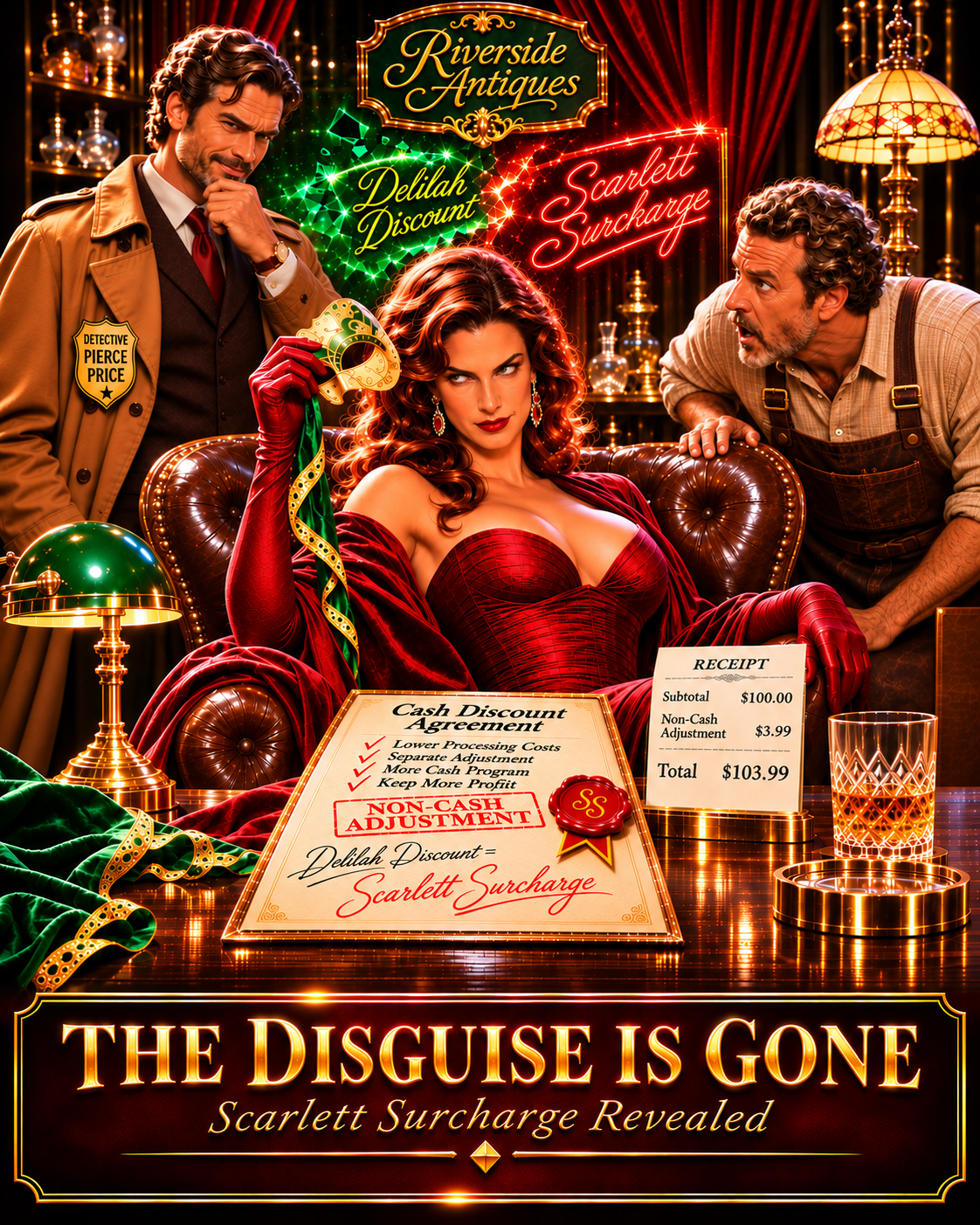
Not every fee with a similar name is automatically a prohibited surcharge. Different fee programs exist and require their own analysis. The point is simpler: an extra amount triggered by card payment cannot escape relevant rules merely because the marketing materials avoid the word 'surcharge.'
Watch Scarlett face the consequences in The Truth Lens — Delilah's interactive reveal. Marty is astonished. Pierce is, unsurprisingly, less impressed.
A Clearer Choice: Dual Pricing
Think of a gas station with two posted prices per gallon. You see a cash price and a card price before you fill up. The price per gallon depends on the payment method you choose. You don't expect an advertised cash price followed by a mysterious per-gallon adjustment on the receipt to make up the difference.
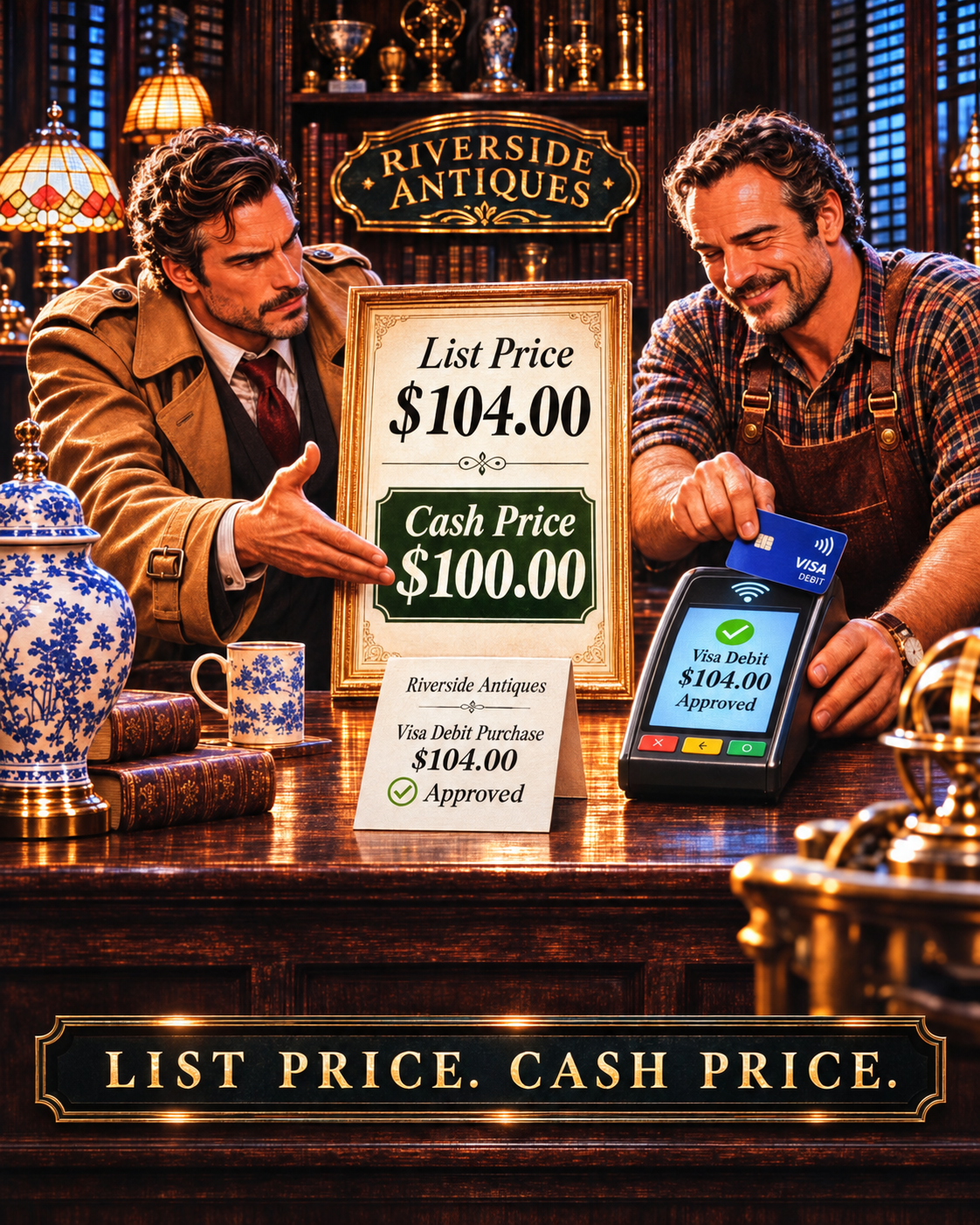
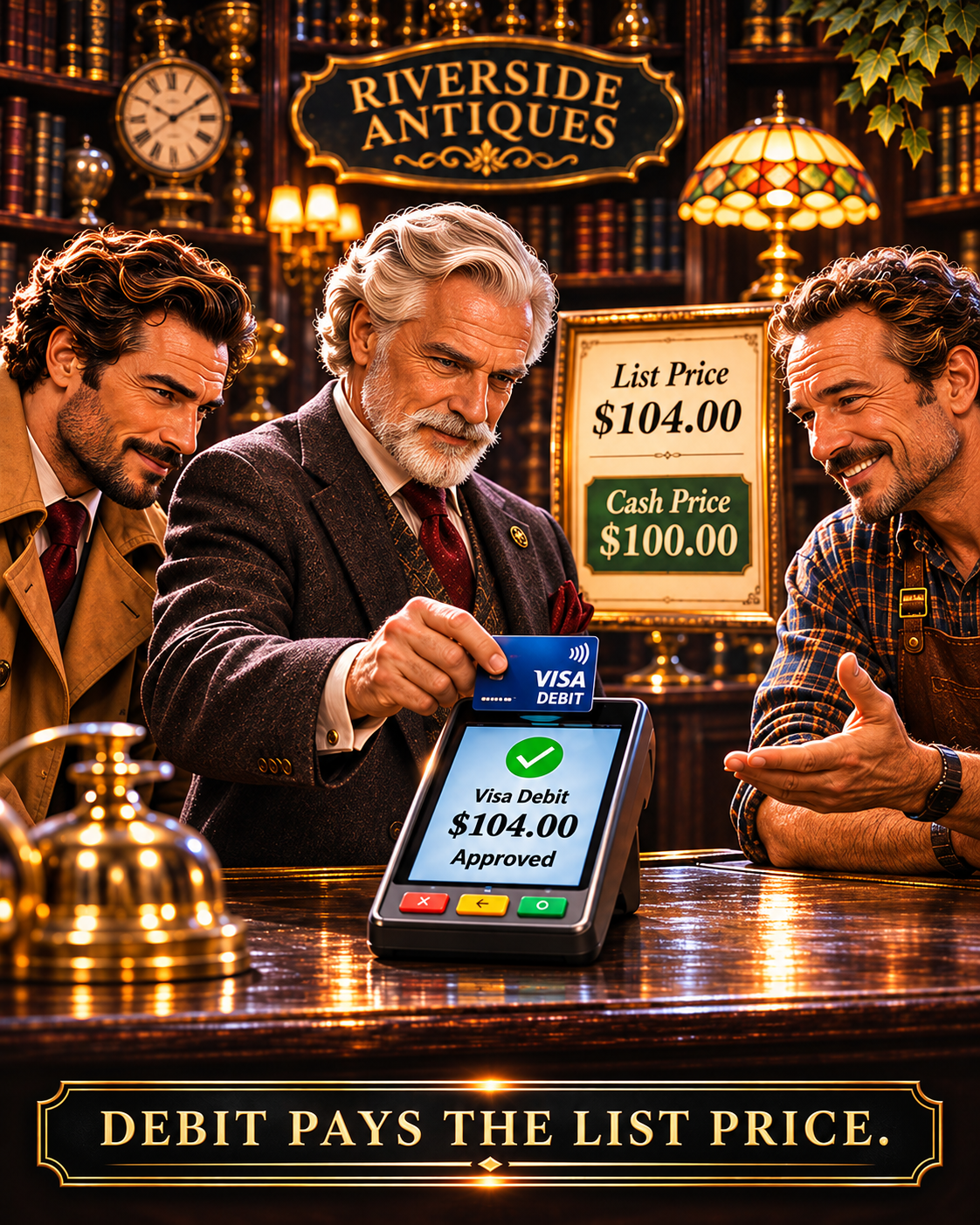
That is the basic appeal of properly presented dual pricing. The higher LIST/CARD price is the regular price, and the lower CASH price is the discount. Ideally both are shown at the shelf, on the menu or wherever customers compare individual items. Applicable state laws may require particular displays.
The POS has two prices in its brain
A POS capable of proper dual pricing can store or calculate the applicable list price and cash price for every item. In other words, it has both prices in its brain, so to speak. That allows it to build the final ticket from the correct prices instead of inventing a generic fee after adding up the lower-priced items.
| Item | List/card | Cash |
|---|---|---|
| Antique picture frame | $52.00 | $50.00 |
| Decorative writing box | $52.00 | $50.00 |
| Total | $104.00 | $100.00 |
When the customer pays with a card, the receipt can show $52 for each item and $104 total. When paying cash, the receipt can show the discounted $50 item prices and $100 total, or a properly calculated cash discount. The prices are not a surprise added after the payment choice.
What about restaurants?
Restaurant guests often see a check before deciding whether to use cash or a card. A good dual-pricing POS can show both the cash and card totals at that point. Where supported, it can also print both prices item by item. Importantly, a dual-total prepayment check does not replace item-level menu/price disclosure required by Visa or additional state-law rules.
The customer should understand the difference while ordering and before giving the server a card. If the only explanation is a little fee line that appears when the terminal activates, the customer experience is already going in the wrong direction.
One More Relative: The All-Tender Admin Fee
There is a less familiar fee model often called an admin-fee program, historically described by some providers as 'reverse cash discount.' The current Exatouch documentation explains a configuration in which an admin fee applies to every tender type — cash, credit, debit, checks and other payments — and is not paired with a cash-tender discount.
| Illustrative all-tender admin fee | Card | Cash |
|---|---|---|
| Regular price | $100.00 | $100.00 |
| Disclosed admin fee | +$3.00 | +$3.00 |
| Total | $103.00 | $103.00 |
If a provider says an admin fee applies to every purchase but then removes it whenever a customer uses cash, ask how the program was configured and which requirements apply. Don't assume a different label settles the compliance question.
Four Programs. Four Different Experiences.
| Program | Card transaction | Cash transaction |
|---|---|---|
| Eligible credit surcharge | $100 plus a permitted, disclosed fee for eligible credit; no Visa/Mastercard debit surcharge | $100 |
| Cash discount | Posted regular price: $104 | $104 minus $4 discount = $100 |
| Dual pricing | Posted list price: $104 | Posted cash price: $100 |
| All-tender admin fee | $100 plus the same disclosed $3 fee | $100 plus the same disclosed $3 fee |
Five Questions That Would Have Saved Marty the Mystery
- What exact item prices will my customers see on the shelf, menu and website before they pay?
- Can this POS correctly identify credit, debit and prepaid cards and handle any fee restrictions?
- Does cash actually reduce a displayed regular price — or does the system add a fee to the lower posted price when someone uses a card?
- Will the guest check, terminal and final receipt tell a consistent story, including itemized prices when required?
- Who has reviewed the specific configuration against card-brand rules, processor requirements and the law where my business operates?
The Merchant Isn't the Villain
Most merchants aren't trying to trick anybody. They're selling products, covering payroll and looking for ways to stop their processing statements from eating the profits. They understandably expect someone selling a payment program to explain how it actually works.
Marty didn't need an even more persuasive enchantress. He needed a provider who would walk him through the choices, configure the system properly, and make sure the customer's experience matched the agreement. Saving on processing costs is a worthwhile goal. Surprising customers with an unexplained adjustment is not.
The Final Reveal
Show the real price. Explain the actual program. Make the point-of-sale system behave the way the pricing promises. Genuine cash discounts, dual pricing and permitted credit-card surcharges can all have their place. The danger begins when the names are clearer than the numbers.
Before signing, look at the shelf price. Then the terminal. Then the receipt. If those three can't agree, you may have a mystery worth investigating. And if a particularly charming woman in emerald velvet offers you a gold pen... perhaps read the agreement first.
Enjoyed the case? The full illustrated adventure goes considerably further. Or investigate your own pricing setup — no trench coat required.
Experience Delilah's Discount Deception — the full interactive story. Meet Delilah, Scarlett, Pierce, Marty and Nora, complete with the theatrical reveal.
Take the Fee Offset Reality Check to examine your own prices, signage and receipt behavior. It is an educational diagnostic, not a remote compliance certification.
Want a second set of eyes on your POS or processing proposal? Request a no-obligation consultation. We'll help you compare the options that actually fit your business.
Educational note: The illustrated merchants and events are fictional. Card-network requirements, approved configurations, processor contracts and federal, state and local laws determine which payment practices are permitted. This article does not certify any program as compliant.
- Visa — U.S. Merchant Surcharging Q&A and cash-discount guidance: https://usa.visa.com/content/dam/VCOM/global/support-legal/documents/merchant-surcharging-qa-for-web.pdfVisa credit cap; no debit/prepaid surcharges; advertised item-price guidance for cash discounts.
- Mastercard — Merchant Surcharge Rules: https://www.mastercard.com/us/en/business/support/merchant-surcharge-rules.htmlMastercard's separate maximum cap, debit/prepaid restriction and disclosures.
- Exatouch — Dual Pricing Program: https://help.exatouch.com/knowledge-base/enable-dual-pricing/POS implementation and cash/list pricing examples.
- Exatouch — Cash/Tender Discounts: https://help.exatouch.com/knowledge-base/enable-tender-discounts/Example of discounting from the regular price.
- Exatouch — Admin Fees: https://help.exatouch.com/knowledge-base/enable-admin-fee/All-tender admin-fee requirements and program distinctions.
Want help comparing the real cost of your options?
We review your current processing and technology setup and help you compare options around how your business actually operates.