The Great POS Gold Rush: Lord Toastly, Sir Shifty & the $10,000 Question

The curtain rises. Lord Toastly barrels in with a glittering $10,000 envelope; Sir Shifty counters with a $5,000 flourish and a marching band of POS terminals. The restaurant owner applauds politely, then asks the question neither showman put on the giant screen: “What happens to my money after the confetti?” Welcome to the Great POS Gold Rush—where the characters are fictional, the offers need real scrutiny, and the five- and six-year calculations matter far more than the size of the opening check.
THE STAGE RULES: Lord Toastly, Sir Shifty and their antics are original fictional satire, not depictions of actual salespeople or proof of misconduct by Toast or Shift4. Dollar examples below are merchant-specific, published promotional examples or explicitly modeled assumptions—not universal terms or guaranteed results.
Want the curtain, the confetti, the Contract Octopus and the whole 16-scene experience first? Enter The Great POS Gold Rush. This article is its detailed, illustrated backstage ledger.

Lord Toastly has brought more gold confetti than any restaurant should reasonably have to sweep up. Sir Shifty arrives in purple with an equally theatrical counteroffer. The merchant smiles: “Lovely. Does either of you have the full written proposal?”
Act I — The Two Showmen and the Very Real Signing Bonus
Lord Toastly's bonus is not automatically a trick. Neither is Sir Shifty's. Providers may offer signing incentives because they expect to earn revenue from a merchant relationship over time. A real, useful upfront check or equipment package deserves credit. The question is what comes with it: payment costs, software, hardware, checkout pricing, annual charges and contractual obligations. A bonus is not automatically money you are “paying back”; whether the arrangement works in your favor depends on the entire offer.
The merchant's new rule is simple: don't ask only whether the check is real. Ask whether the full arrangement beats the alternatives over the years you expect to use it. The most expensive mistake isn't accepting a bonus; it's comparing the envelope while ignoring everything printed behind it.
Evaluate the whole arrangement: processing, checkout pricing, SaaS, hardware, annual fees, contract obligations, and any recurring benefits. The bonus is one line item in a larger picture.
Act II — The Fine Print Has Entered the Chat
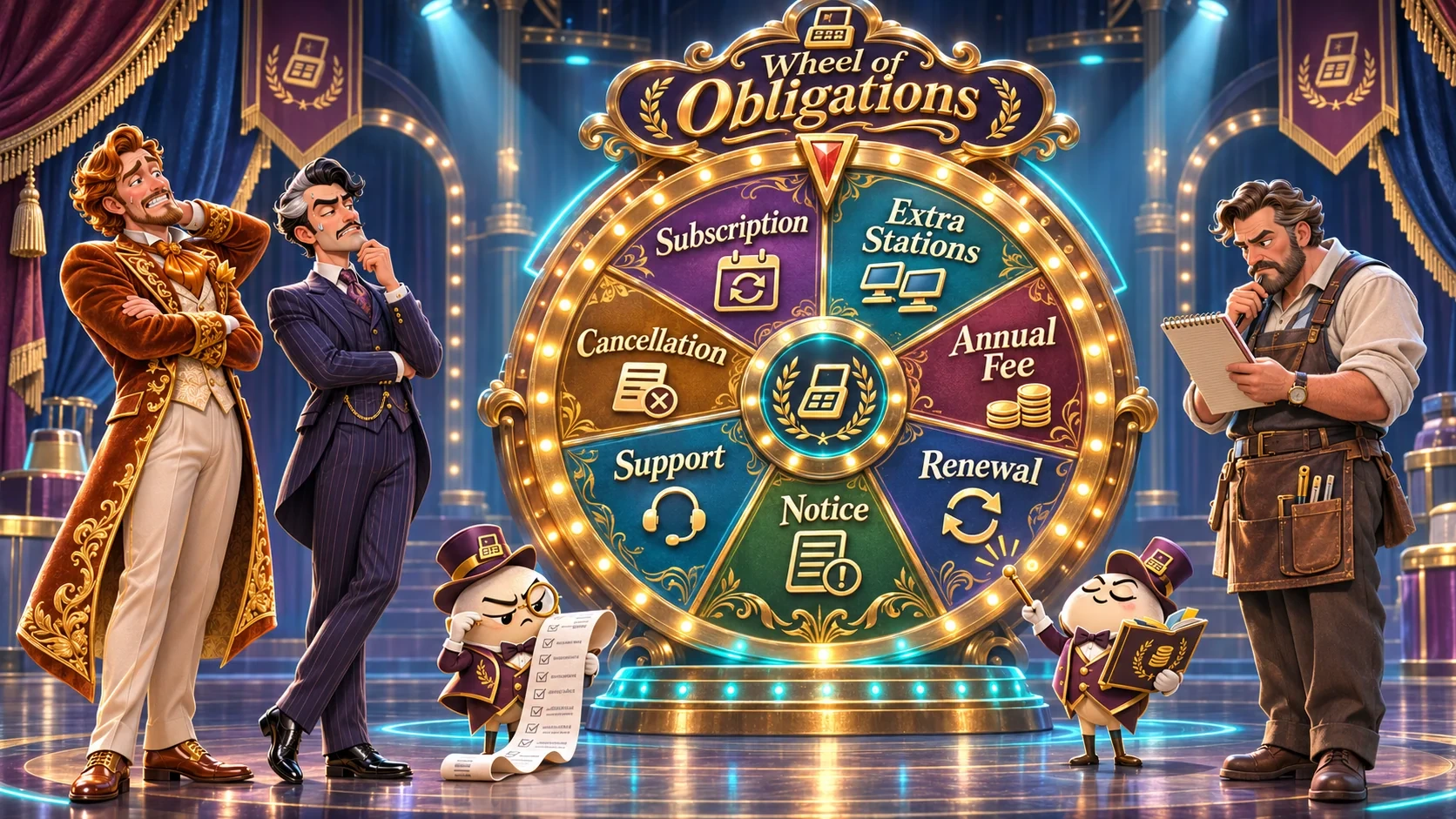
You don't need a finance degree, an enchanted abacus or Sir Shifty's dramatic cape. You do need the actual written terms and a consistent timeline. Ask for these seven ingredients before you let either showman back near the confetti cannon:
- Your monthly card volume (the dollars you run through the system)
- The effective processing cost you'll carry under the new offer (total fees ÷ volume)
- The monthly software / POS fees for the contract term
- Any annual service, maintenance, or program fees
- The upfront hardware cost and any equipment or placement credits
- The contract length and any early-termination exposure
- Whether there is a recurring payout or offset — or only the upfront check

Act III — Lord Toastly's $10,000: Day One vs. Year Five
For our first backstage calculation, imagine a restaurant processing $60,000 a month in card sales. Lord Toastly proudly unveils a $10,000 upfront-bonus scenario with traditional processing. The advisor sets an approved Prime49-style recurring model beside it. These are deliberately illustrative assumptions, not verified Toast transaction rates or a merchant-specific Prime49 approval. Watch the math—not the stage lighting.
Arrangement A — $10,000 Upfront Bonus With Traditional Processing
- Monthly card volume: $60,000
- Assumed effective merchant processing cost: 3% = $1,800 per month
- Monthly SaaS: $750
- Monthly merchant payout: $0
- Upfront signing bonus: $10,000
- Annual service fees: $0 assumed
- Upfront equipment cost: $0 assumed (favorable to the bonus arrangement)
The music stops for arithmetic: $1,800 in monthly processing plus $750 in software equals $2,550 going out every month. At that modeled price for 60 months, that's $153,000; subtract the $10,000 bonus and the five-year net outflow is $143,000. Stretch the same *assumption* to 72 months and it's $183,600 before the bonus or $173,600 after it. The confetti is free; the longer timeline is only an illustration, not a claim that any particular 24-month promotional rate lasts six years.
The $750 SaaS figure corresponds to a reported minimum in a particular October 2026 Toast signing promotion — not to every Toast merchant or plan. Its disclosed initial commitment is 24 months; carrying that price for five or six years is only a modeling assumption. The 3% processing rate is a hypothetical, not a verified Toast quote.
Before Lord Toastly can fire another cannon, the advisor interrupts: “A ten-thousand-dollar bonus belongs on the benefits side. So do useful included devices. But monthly processing, software and any annual charges belong on the cost side. And the alternatives must be compared using the same timeframe.”
Arrangement B — Prime49
- Monthly card volume: $60,000
- Approved 5% dual-pricing structure, using appropriately displayed cash and card prices
- Eligible merchant-paid processing costs are fully offset through the approved pricing arrangement
- Original POS software cost: $400 per month
- Software coverage through the approved arrangement: $300 per month
- Merchant's remaining software expense: $100 per month
- Recurring Prime49 payout: 0.40% × $60,000 = $240 per month
- Upfront cash signing bonus: $0
- Annual program fees: $0 assumed
- Eligible equipment cost is covered up to the approved $4,500 placement credit in this example
The advisor draws one green line on the ledger: $240 in modeled recurring Prime49 payouts minus $100 in remaining software expense equals +$140 per month. At unchanged, approved assumptions, that is $8,400 received after software over five years or $10,080 over six. The payout and coverage are approval- and activity-dependent, not promises for every merchant.
One important backstage reveal: these are NOT identical pricing experiences for restaurant guests. The traditional-processing example assumes the merchant absorbs card costs; the Prime49 illustration assumes properly displayed dual pricing that offsets eligible costs. The resulting figures compare merchant cash flow, not guaranteed extra profit. Customer-facing prices, purchasing behavior, real processor terms and eligibility can change the outcome.
Arrangement A — Upfront Bonus
$10,000 today- Monthly card volume
- $60,000
- Processing cost (3%)
- −$1,800
- Monthly SaaS
- −$750
- Monthly payout
- $0
- Upfront bonus
- +$10,000
- Monthly ongoing cost
- −$2,550
Arrangement B — Prime49
Recurring payout- Monthly card volume
- $60,000
- Merchant-paid processing (offset)
- $0 eligible*
- Net monthly software
- −$100
- Monthly payout
- +$240
- Upfront bonus
- $0
- Net monthly cash flow
- +$140
Where the five- and six-year totals come from
Green amounts come into the business; red amounts leave it. Each net result below includes the signing bonus, monthly costs, and payouts for that period.
5 years (60 mo)
Arrangement A — Upfront Bonus
- Signing bonus received
- +$10,000
- Processing: $1,800 × 60 months
- −$108,000
- Software: $750 × 60 months
- −$45,000
Arrangement B — Prime49
- Prime49 payouts: $240 × 60 months
- +$14,400
- Software: $100 × 60 months
- −$6,000
- Eligible merchant-paid processing (offset)
- $0
$143,000 going out with Arrangement A + $8,400 coming in with Prime49 = $151,400 cash-flow difference.
6 years (72 mo)
Arrangement A — Upfront Bonus
- Signing bonus received
- +$10,000
- Processing: $1,800 × 72 months
- −$129,600
- Software: $750 × 72 months
- −$54,000
Arrangement B — Prime49
- Prime49 payouts: $240 × 72 months
- +$17,280
- Software: $100 × 72 months
- −$7,200
- Eligible merchant-paid processing (offset)
- $0
$173,600 going out with Arrangement A + $10,080 coming in with Prime49 = $183,680 cash-flow difference.
This is a modeled merchant cash-flow comparison, not a guarantee of additional profit. The two arrangements have different customer-facing checkout prices; the difference depends on pricing, volume, sales behavior, and approved program terms.
Prefer to watch the sales pitch collide with reality? See the staged offer showdown and the fine-print parade. The detailed assumptions and charts remain below for anyone who wants to audit the math.

Intermission — The Hardware Parade Has a Price Tag
The POS hardware joins the parade, because terminals, kitchen displays and printers matter. For a fair three-station comparison, imagine both providers supplying the same equipment package valued at $4,300. At the illustrative $60,000 monthly volume, assume Prime49 approves a $4,500 equipment placement credit: $4,300 covers the matched hardware package, leaving the merchant $0 out of pocket. The unused $200 is not cash and is not added to any payout. Actual eligible equipment and placement obligations must be confirmed in the written proposal.
Sir Shifty protests that his included equipment has value. The advisor agrees. In this matched illustration, Sir Shifty supplies the same $4,300 three-station package at $0 upfront and Prime49 uses $4,300 of its $4,500 approved placement credit. Neither merchant pays for the hardware upfront; neither hardware benefit is counted as extra cash. Equipment ownership, return obligations and the rest of each agreement still need to be reviewed.
- Eligible equipment package
- $4,300
- Placement credit applied
- −$4,300
- Merchant out-of-pocket
- $0
Same illustrative three-station equipment as the Shift4 scenario. The unused $200 credit is not paid out.
Apples to apples: both offers include the same assumed $4,300 three-station package, and both leave $0 out of pocket for equipment. The Shift4 cash bonus remains a separate $5,000 benefit. Prime49's $4,500 credit is used only toward eligible equipment, not added as cash; its unused $200 has no cash value. That is why hardware does not change the five- or six-year cash-flow difference below.

Act IV — Sir Shifty's $5,000 and the Hardware Parade
Sir Shifty reappears carrying TWO things: a $5,000 cash signing bonus and a parade of equipment included at $0 upfront in this qualifying example. We assume an illustrative equipment provision worth up to $5,000, more than enough to cover the same $4,300 three-station package used for Prime49. A Shift4 Dine (formerly SkyTab) authorized reseller publicly advertises $0 upfront hardware on up to four qualifying devices alongside a $5,000 signing incentive; it does not publish a universal $5,000 hardware-value cap, so that equipment allowance is a scenario assumption, not a claim about every offer. The alternative twelve-month software-free promotion cannot be combined with the $5,000 cash bonus. Confirm the exact equipment and terms in writing.
Then the Contract Octopus raises one tentacle: “Annual Service & Maintenance Fee?” Shift4 documents this category of charge, while independent consultants have reported some 2026 merchant notices in the $1,500–$2,000 annual range. Those amounts are not verified charges for every new merchant. They appear in the illustration conditionally, so that a proposed annual fee is considered when it applies—not assumed to apply to everyone.
A Three-Station Shift4-Style Arrangement (Illustrative)
- Monthly card volume: $60,000
- Approved dual pricing that fully offsets eligible merchant-paid processing expenses
- $5,000 upfront bonus
- Three matched POS stations: illustrative $4,300 hardware package, covered at $0 upfront (within an assumed $5,000 equipment allowance)
- Three POS stations: approximately $100 in total monthly software costs, excluding add-on services
- Annual service & maintenance expense of $1,500–$2,000, if applicable to that merchant
- No recurring processing-volume payout
With three POS stations at an assumed $100 total in monthly software costs, excluding add-on services, and a conditional $1,500–$2,000 annual service fee, the Shift4-style illustration nets $8,500–$11,000 in merchant costs over five years after subtracting the $5,000 bonus. Over six years, it nets $11,200–$14,200. Sir Shifty has not been convicted of anything by a calculator; we are only testing an assumed proposal.
For this second example, keep the same $60,000 in monthly card volume, the same three POS stations and the same illustrative $4,300 hardware package for BOTH offers. Shift4 includes the equipment at $0 upfront; with a separately approved $4,500 Prime49 placement credit, the matching hardware also costs $0 out of pocket. Assuming an eligible Prime49 configuration covers all three POS software licenses ($20,000 of monthly volume per license × three), the remaining license expense is $0—not the $100 software cost in Example One, which used a different package. Prime49's modeled $240 monthly payout thus nets +$14,400 over five years or +$17,280 over six, excluding add-on services. Against Shift4, the illustrative merchant cash-flow difference remains $22,900–$25,400 over five years and $28,480–$31,480 over six. Equipment is equal on both sides and is not double-counted as cash. Actual program approval, customer-facing pricing, equipment terms and contract obligations still matter.
Shift4-Style — $5,000 Bonus
Upfront + dual pricing- Monthly card volume
- $60,000
- Matching 3-station hardware ($4,300)
- $0 out of pocket
- Merchant-paid processing (offset)
- $0 eligible*
- Monthly software (3 stations; est.)
- −$100
- Annual service (if applicable)
- −$1,500–$2,000/yr
- Monthly payout
- $0
- Upfront bonus
- +$5,000
Prime49 — Same Volume
Recurring payout- Monthly card volume
- $60,000
- Matching 3-station hardware ($4,300)
- $0 out of pocket
- Merchant-paid processing (offset)
- $0 eligible*
- POS software (3 covered licenses)
- $0
- Annual service (assumed)
- $0
- Monthly payout
- +$240
- Upfront bonus
- $0
Where the five- and six-year totals come from
Green amounts come into the business; red amounts leave it. Each net result below includes the signing bonus, monthly costs, and payouts for that period.
5 years (60 mo)
Shift4-Style — $5,000 Bonus
- Signing bonus received
- +$5,000
- Software: $100 × 60 months
- −$6,000
- Annual service: $1,500–$2,000 × 5
- −$7,500 to −$10,000
Prime49 — Same Volume
- Prime49 payouts: $240 × 60 months
- +$14,400
- POS licenses: 3 covered × 60 months
- $0
- Eligible merchant-paid processing (offset)
- $0
Matched three-station hardware: $0 out of pocket on both sides. $8,500–$11,000 going out with Shift4 + $14,400 coming in with Prime49 = $22,900–$25,400 cash-flow difference. Neither hardware benefit is treated as extra cash.
6 years (72 mo)
Shift4-Style — $5,000 Bonus
- Signing bonus received
- +$5,000
- Software: $100 × 72 months
- −$7,200
- Annual service: $1,500–$2,000 × 6
- −$9,000 to −$12,000
Prime49 — Same Volume
- Prime49 payouts: $240 × 72 months
- +$17,280
- POS licenses: 3 covered × 72 months
- $0
- Eligible merchant-paid processing (offset)
- $0
Matched three-station hardware: $0 out of pocket on both sides. $11,200–$14,200 going out with Shift4 + $17,280 coming in with Prime49 = $28,480–$31,480 cash-flow difference. Neither hardware benefit is treated as extra cash.

Act V — The Processing Cost Doesn't Vanish by Magic
The showmen demand to know whether Prime49 knows actual magic. It doesn't. Card acceptance has a cost. An approved dual-pricing arrangement uses properly disclosed list/card and cash prices to offset eligible merchant-paid costs through customer-facing price choices; it does not make the economics vanish. Depending on approval, volume and setup, related software or equipment coverage and a recurring payout may be available. Those trade-offs belong in the merchant's decision.
If the cash price is $20.00 and the card price is set 5% higher, the card price is $21.00. Customers must see the appropriate advertised card and cash prices before checkout, according to the applicable payment-network rules, laws, and approved processor setup. The merchant may use an approved structure that offsets eligible card-acceptance costs and supports the recurring program payout. Customer purchasing behavior, the business's pricing decisions, and the actual costs are all relevant when evaluating overall profitability.
A competitor may also offer dual pricing — Prime49 is not the only program using that method. Its distinct proposition here is the particular combination of approved pricing choices, cost coverage, equipment placement, and ongoing payouts tied to processing activity.
Act VI — The Contract Octopus and the Fine Print
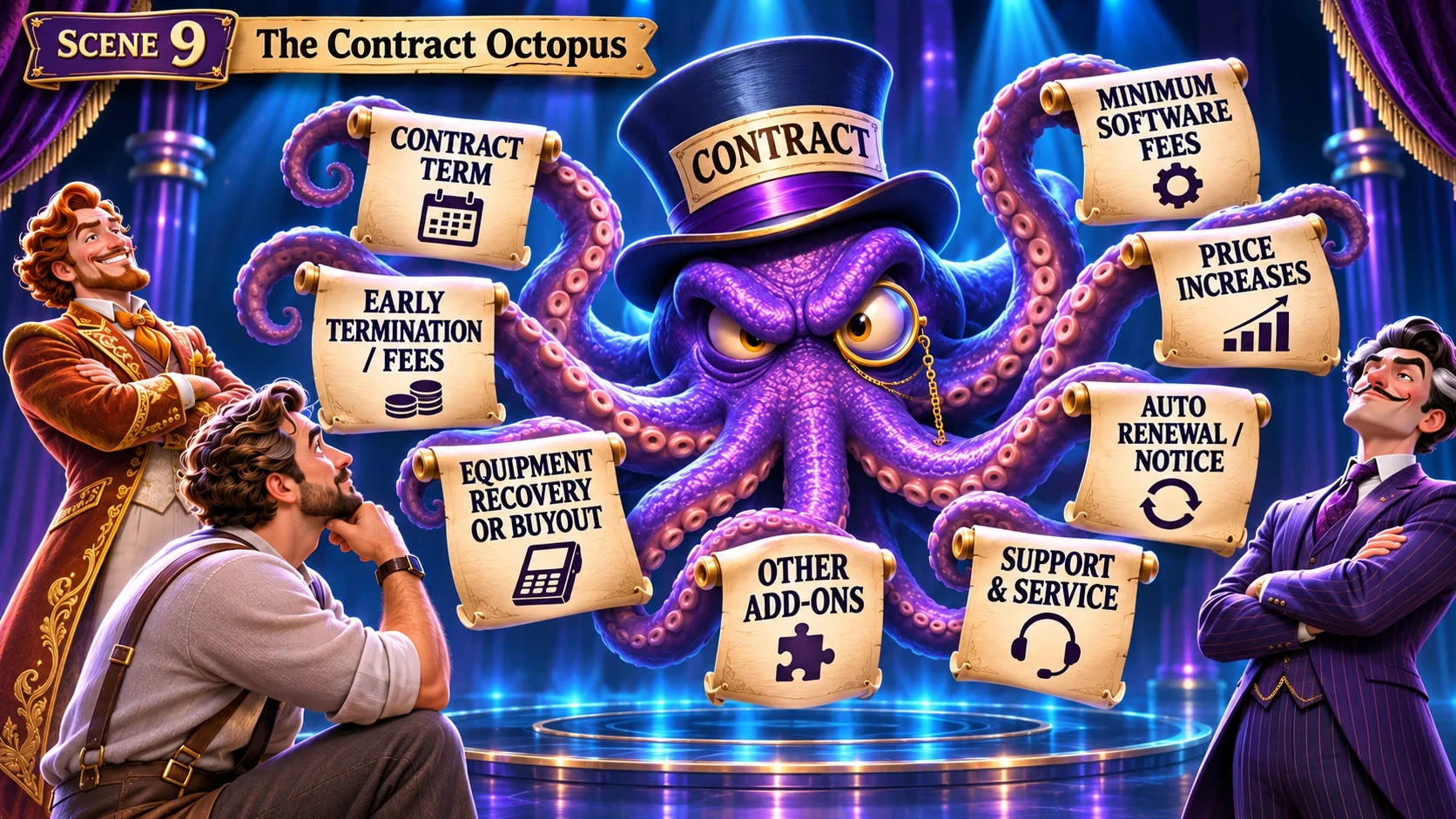
The Contract Octopus politely unfurls eight arms, each holding a different page. The restaurant owner finally asks what matters: “What will I pay, what exactly is included, and how do I leave?” Obtain monthly SaaS, full processing economics, annual charges, hardware and placement credits, renewal and notice provisions, plus any early-exit or clawback provisions in writing. Not every fee is unreasonable or hidden. The important distinction is that it should be clear before the merchant agrees.
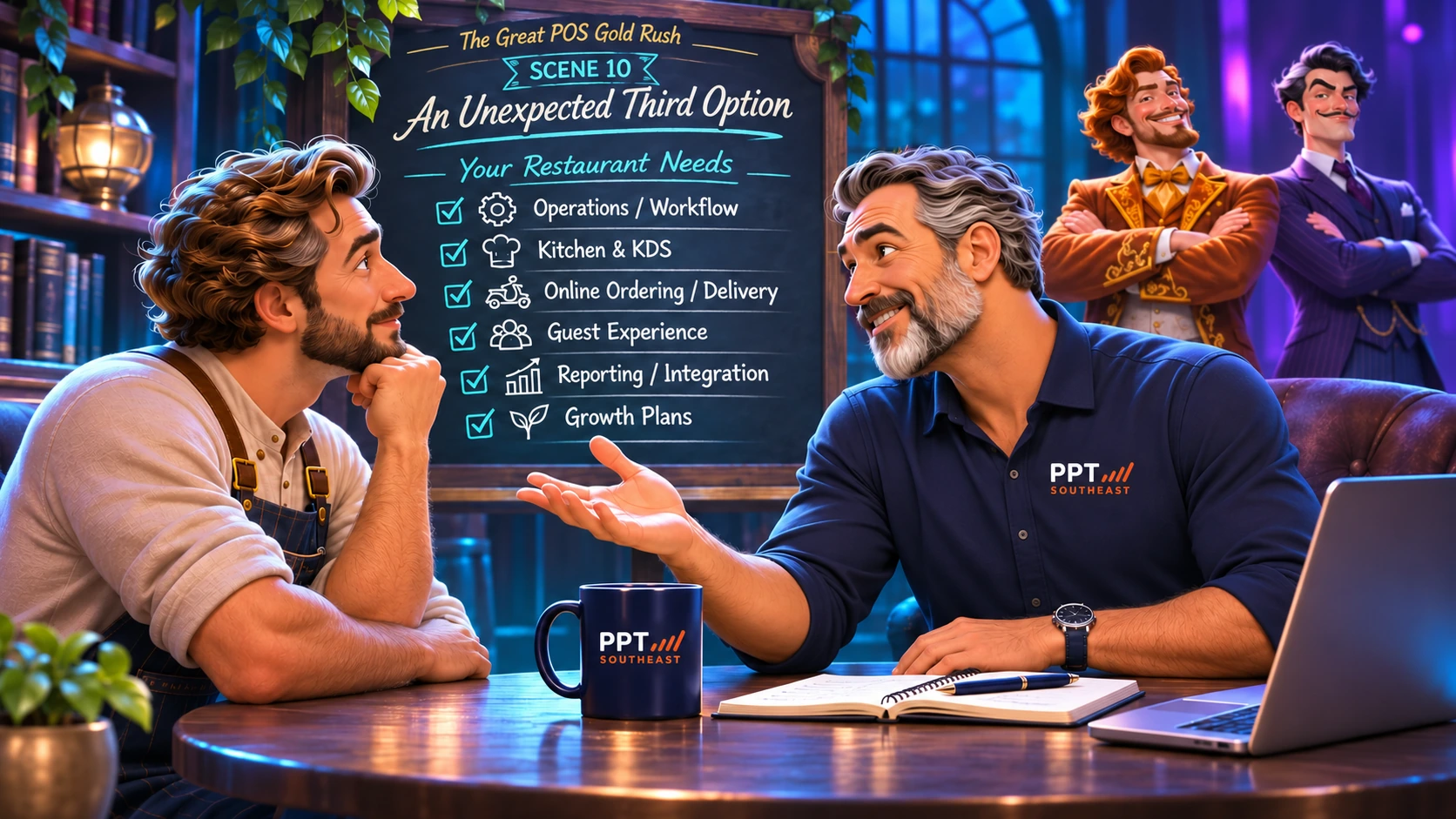
And do not forget the restaurant itself. A useful POS must handle its real ordering, kitchen, staffing, online sales, reporting and support needs. Ask the provider to explain the setup and every applicable cost—not simply repeat the promotional headline.
Eight Questions That Make the Contract Octopus Nervous
- What is my effective processing cost today, and what will it be under this offer?
- What software or POS fees am I paying monthly, and for how long?
- Are there annual service, maintenance, or program fees — and how much are they?
- How long is the contract, and what does it cost to exit early?
- Is the bonus clawed back if I leave before the term ends?
- Is there a recurring payout or offset, or only the upfront check?
- Is there an equipment placement credit, and what equipment does it cover?
- Does the system actually fit how my business operates?

Finale — Give the Trophy to the Merchant
At the finale, Lord Toastly lowers his trumpet. Sir Shifty stops straightening his purple lapels. The merchant lifts the RIGHT FIT trophy because the final decision weighs more than the check: processing and guest-facing prices, monthly software, annual charges, equipment, support, flexibility and any verified ongoing benefit. A signing bonus can be a terrific deal. It can also be outweighed by a weaker long-term arrangement. The winner is the merchant who can see the full numbers before signing.
Want a second set of eyes on the offer in front of you? We review your current processing and technology setup and help you compare options around how your business actually operates. Request a technology and payment review.
A Factual Footnote Outside the Fiction
A separate real-world development is discussed in the interactive Gold Rush story. On October 29, 2026, the FTC and state and local co-plaintiffs filed a lawsuit against Toast and affiliated entities alleging certain fee, cancellation and support practices. The case is pending. The allegations are not court findings, and Toast strongly disputes them. This lawsuit is not an allegation about the specific fictional $10,000 offer modeled here, and Shift4 is not named as a defendant in that case.
Read the factual materials directly in the sources below: the FTC case page and Toast's own response. For the characters, stage and fictional adventure, return to The Great POS Gold Rush.
Still want the version with curtains, sound and an outrageous amount of gold? Watch The Great POS Gold Rush. Prefer another illustrated merchant mystery? Meet Delilah Discount and Detective Pierce Price.
Backstage Notes: Sources and Assumptions
The underlying promotional examples and assumptions were assembled in October 2026; they may expire, change or apply only to certain merchants. The fictional showmen are not representatives of the companies mentioned. All real eligibility, equipment, fees, pricing and commitments must be verified in the final written proposal.
- FTC case against Toast (filed October 29, 2026; pending): https://www.ftc.gov/legal-library/browse/cases-proceedings/252-3101-toast-incAllegations, not findings; distinct from the fictional story and its illustrative bonus examples.
- Toast's response to the FTC lawsuit (October 29, 2026): https://pos.toasttab.com/vi-us/news/toast-responds-ftc-lawsuitToast strongly disputes the allegations.
- SkyTab $5,000 signing-bonus eligibility: https://www.skytabshift.com/5k-incentiveAdvertised processing-volume threshold; confirm current, complete written conditions.
- Toast $10k offer (legal/terms): https://pos.toasttab.com/legal/10kofferPromotion terms; verify accessibility and current terms directly.
- Toast published pricing: https://pos.toasttab.com/pricing
- Shift4 authorized-reseller promotions: https://shift4direct.com/promotions/
- Shift4 billing glossary (Annual Service & Maintenance Fee): https://shift4.zendesk.com/hc/en-us/articles/14382700830739-End-to-End-Billing-Matrix-Statement-Glossary
- Independent Shift4 fee reporting (Merchant Cost Consulting): https://merchantcostconsulting.com/lower-credit-card-processing-fees/shift4-rate-increases-fees-updates/Independent reporting of 2026 merchant notices; amounts vary and are not verified for every merchant.
- Visa — cash discount vs. surcharge guidance: https://usa.visa.com/dam/VCOM/global/support-legal/documents/merchant-surcharging-qa-for-web.pdf
- Prime49: https://payprotecsoutheast.com/prime49
Want help comparing the real cost of your options?
We review your current processing and technology setup and help you compare options around how your business actually operates.