Business Solution Technologies - PayProTec Southeast

Pricing & Payment Options

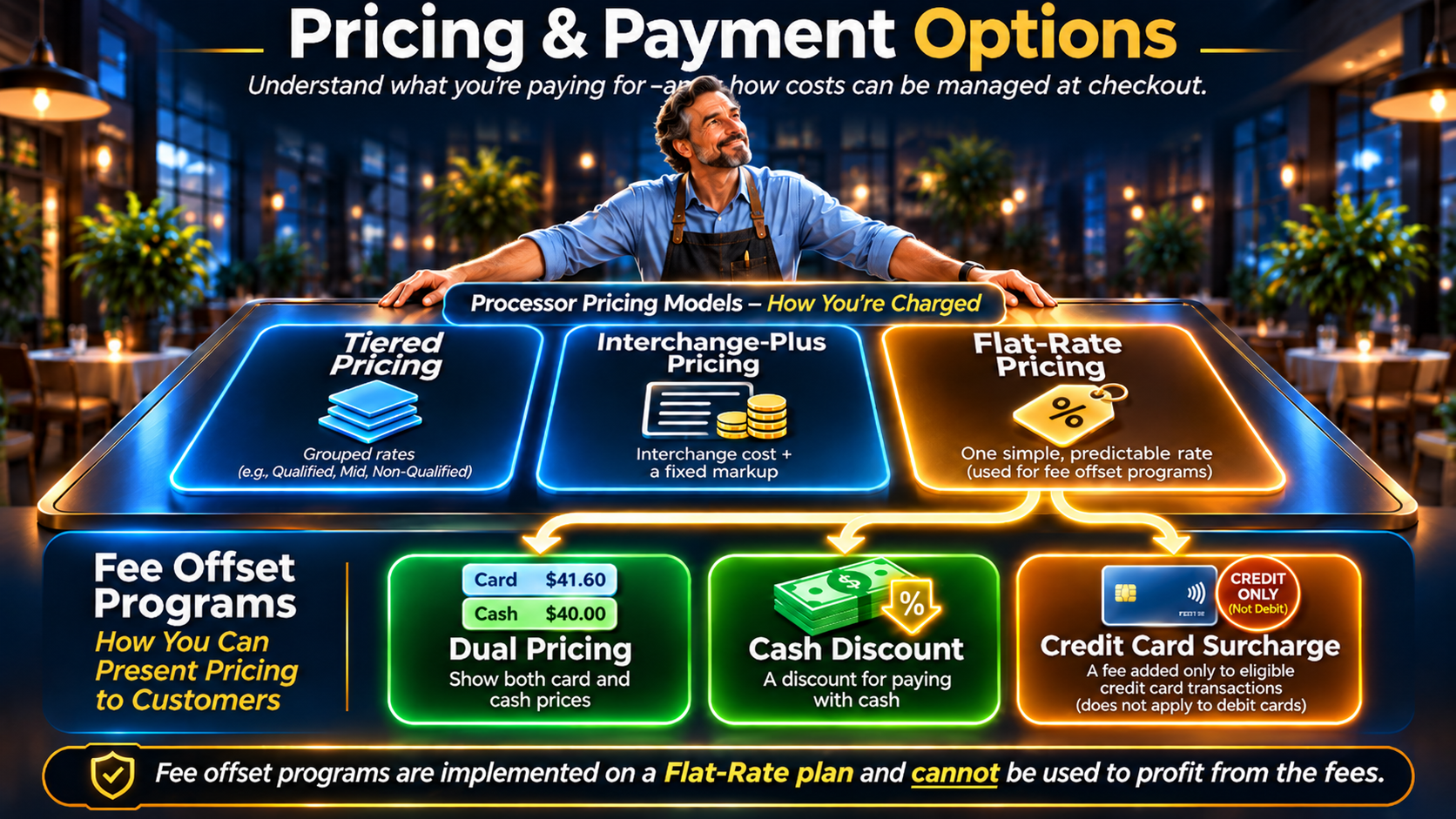
Pricing & Payment Options: Understand what you're paying for and how costs can be managed at checkout. Shows Processor Pricing Models (Tiered Pricing with grouped rates, Interchange-Plus Pricing with interchange cost plus fixed markup, and Flat-Rate Pricing with one simple predictable rate) connecting to Fee Offset Programs (Dual Pricing showing card and cash prices, Cash Discount with discount for cash, and Credit Card Surcharge on eligible credit cards), with compliance note that fee offset programs are implemented on a flat-rate plan and cannot be used to profit from fees.
PRICING & PAYMENT OPTIONS

Understand What You're Actually Paying.

A low advertised rate can sound attractive, but it doesn't always tell you what your business will actually spend. How transactions are priced, the cards your customers use, additional fees and the technology surrounding your account can all affect your true processing cost.

We help you look beyond one number, understand the complete picture and compare the payment structure that makes sense for the way your business operates.

LOOK BEYOND THE ADVERTISED NUMBER

The Rate You're Quoted Isn't Always the Rate You Pay.

Some pricing structures classify transactions into categories—commonly described as qualified, mid-qualified and non-qualified. The attractive rate a merchant is quoted may apply only to certain transactions, while other card types and transaction methods land in higher-cost categories.

Different card types, transaction methods and account fees can cause your actual overall processing cost to be quite different from the advertised number. That's why the rate on a flyer rarely matches the total on your monthly statement.

Pricing Structure

How the account is structured—tiered, flat-rate or interchange-plus—affects the final cost of every transaction.

Card & Transaction Mix

Different cards and transaction methods—rewards, corporate, keyed-in vs. swiped—can carry different underlying costs.

Additional Fees

Monthly, transaction, gateway and other applicable charges can add up and affect the total you actually pay.

Technology Costs

POS software, equipment and related services should be considered alongside processing—not viewed in isolation.

That's why we prefer reviewing the complete processing setup instead of selling a merchant on one attractive number.

HOW DOES YOUR PROCESSOR CHARGE YOU?

The Three Common Processing Pricing Models

First, imagine ordering dinner from three restaurants that price the same dish differently. Then switch seats and see what tiered, interchange-plus and flat-rate processing can charge your business for the same $100 sale. Expand a model below for the deeper explanation.

First, imagine you're the customer

What if your restaurant priced dinner like a payment processor?

Imagine the same chicken entrée costs $8 to prepare. Three restaurants sell that exact plate—but each chooses a different way to set the price. Which menu would you prefer?

Same meal. Three different pricing models.

TIERED PRICING

Price by category

$22

Premium bucket

The chef's cost is $8, but this plate is put in the $22 “premium” bucket. Another $8 plate in the “standard” bucket might cost just $12.

You pay for the bucket it landed in—not necessarily its real cost.

INTERCHANGE-PLUS PRICING

Cost + Markup

$13

$8 cost + $5 markup

The restaurant starts with the $8 cost of making the plate and adds its clearly stated $5 markup. The price follows the actual cost.

You can see the cost and what the restaurant adds.

FLAT-RATE PRICING

One set price

$16

Every lunch entrée

All lunch entrées are $16, whether they cost the kitchen $5, $8 or $12. Easy to understand, but cheaper plates can cost more than you'd expect.

Predictable price, regardless of the underlying cost.

Made-up restaurant prices to explain the idea. Actual restaurant menus also account for labor, overhead, demand and other costs; this is a metaphor, not a recommended menu pricing formula.

Now switch seats. You're the merchant.

Your card processor is the restaurant. Your transactions are the dishes.

Different cards have different underlying acceptance costs—just as dishes cost different amounts to make. A tiered processor sorts them into its own price buckets. Interchange-plus passes through the applicable card costs and adds its stated markup. In other words, interchange-plus means cost + markup, with applicable card-network charges also included. Flat-rate applies the same published blended rate to the same type of transaction, even when the cards cost different amounts to accept.

The question: Are you paying for what a card actually costs, or for the bucket your processor puts it in?

Let's try a real-world-style $100 sale.

The customer spends $100 either way. Pick the card they pay with; watch what the merchant is charged by each fictional pricing plan.

Selected: Rewards credit. The customer uses a rewards credit card.

Tiered pricing

The processor puts this sale in its Mid-qualified price bucket.

$2.90

2.80% + 10¢ on $100

The tier—not an itemized view of underlying card costs—sets this example's fee.

Interchange-plus

Applicable card costs, with processor markup shown separately.

$2.25

$1.80 interchange + $0.15 network + $0.30 markup

You can inspect what the underlying costs and processor's share are in this example.

Flat-rate

One published rate for this type of in-person sale, regardless of the selected card.

$2.90

2.80% + 10¢ on $100

Easy to predict. It doesn't pass through a lower underlying card cost to you.

See why that matters?

In this made-up rewards credit example, tiered pricing charges $2.90 while interchange-plus charges $2.25. That's $0.65 more under the tiered plan for the exact same $100 sale. Flat-rate stays at $2.90.

Just like a diner, you should know why you're paying more. Ask your processor how your transactions qualify—and what its markup really is.

These are invented card costs, rates and tier assignments. Real rewards cards do not necessarily fall into a higher tier, and interchange-plus is not always the cheapest option. The best arrangement depends on your card mix, channel, pricing agreement, monthly charges and other fees. These are merchant processing charges, not surprise additions to the customer's $100 bill.

See the three processing methods illustrated

Compare how a $100 restaurant payment is evaluated across tiered, interchange-plus, and flat-rate models.

1. Tiered — three buckets
2. Interchange-plus — costs + markup
3. Flat-rate — one simple price

Artwork is conceptual. A flat rate can differ for in-person, keyed and online transactions. Actual network fees and assessment charges depend on card type, network, transaction details and processor agreement.

Processing model illustration

1×

Use + to zoom and scroll to inspect the details. Close or press Escape to return.

SIMPLE AND PREDICTABLE

Flat-rate pricing

A blended rate per transaction category. Square helped make this model familiar.

The provider charges a published blended rate instead of separately billing the interchange cost for every card. That can simplify budgeting, particularly for a new business. However, in-person, online and keyed-in payments may carry different rates, and software or account charges may apply.

Hypothetical example, not a provider quote

$100 sale × 2.8% + 10¢ = $2.90

Why merchants consider it

Straightforward to understand; easy to forecast when transaction types are predictable.

What to watch

The same blended rate can cost more on cards with lower underlying interchange. Compare all transaction channels and fees.

QUALIFIED, MID-QUALIFIED, NON-QUALIFIED

Tiered pricing

The advertised qualified rate might apply to only a fraction of your transactions.

In tiered pricing, the processor sorts transactions into its own qualified, mid-qualified and non-qualified buckets. Rewards cards, commercial cards, keyed-in payments, missing transaction data, late settlement and other contract-specific conditions may push transactions into more expensive tiers.

Qualified: advertised low tier
Mid-qualified: higher tier
Non-qualified: often highest tier

Tiered pricing is not inherently dishonest. But historically, quoting only the qualified rate while leaving downgrade rules obscure could mislead merchants about their true costs. The buckets are processor-defined, not the published interchange schedule.

Ask: What share of my real card mix will qualify, and what exactly causes a downgrade?

Why merchants consider it

A short pricing schedule can be easy to read when the qualification criteria are disclosed.

What to watch

Processor-defined tiers and downgrades can obscure markup and make competing offers hard to compare.

SEE WHAT YOU ARE PAYING FOR

Interchange-plus pricing

Underlying card interchange, applicable network charges, plus the processor markup.

Interchange-plus separates underlying card costs from processor charges. Visa and Mastercard publish interchange schedules; card type and transaction details determine which categories apply. Interchange and network fees may fluctuate independently of your processor's agreed markup.

Illustrative $100 transaction — not a rate quote

Interchange
$1.80
Network fees
$0.15
Processor markup
$0.30

Illustrated total: $2.25

Hypothetical amounts; separate monthly and other fees may apply.

Even if the statement is longer, it can make the processor markup easier to audit against the agreement. For example, 0.20% equals 20 basis points. If your contracted markup changes, you have a number to question. However, always check other processor fees too; a rise in effective cost alone does not prove a markup increase.

Why merchants consider it

Greater visibility into interchange, network charges and processor markup.

What to watch

Longer statements need review; verify how network fees, monthly fees and other charges are treated.

WHAT PRICE DOES YOUR CUSTOMER SEE?

Fee-Offset Programs: Similar Names, Different Rules

Your processing rate is one decision; how you present prices to customers is another. Expand a program to learn the difference.

Prefer the full detective walkthrough with illustrations? Read the illustrated article.

A familiar example • dinner at a restaurant

The price should make sense before you order.

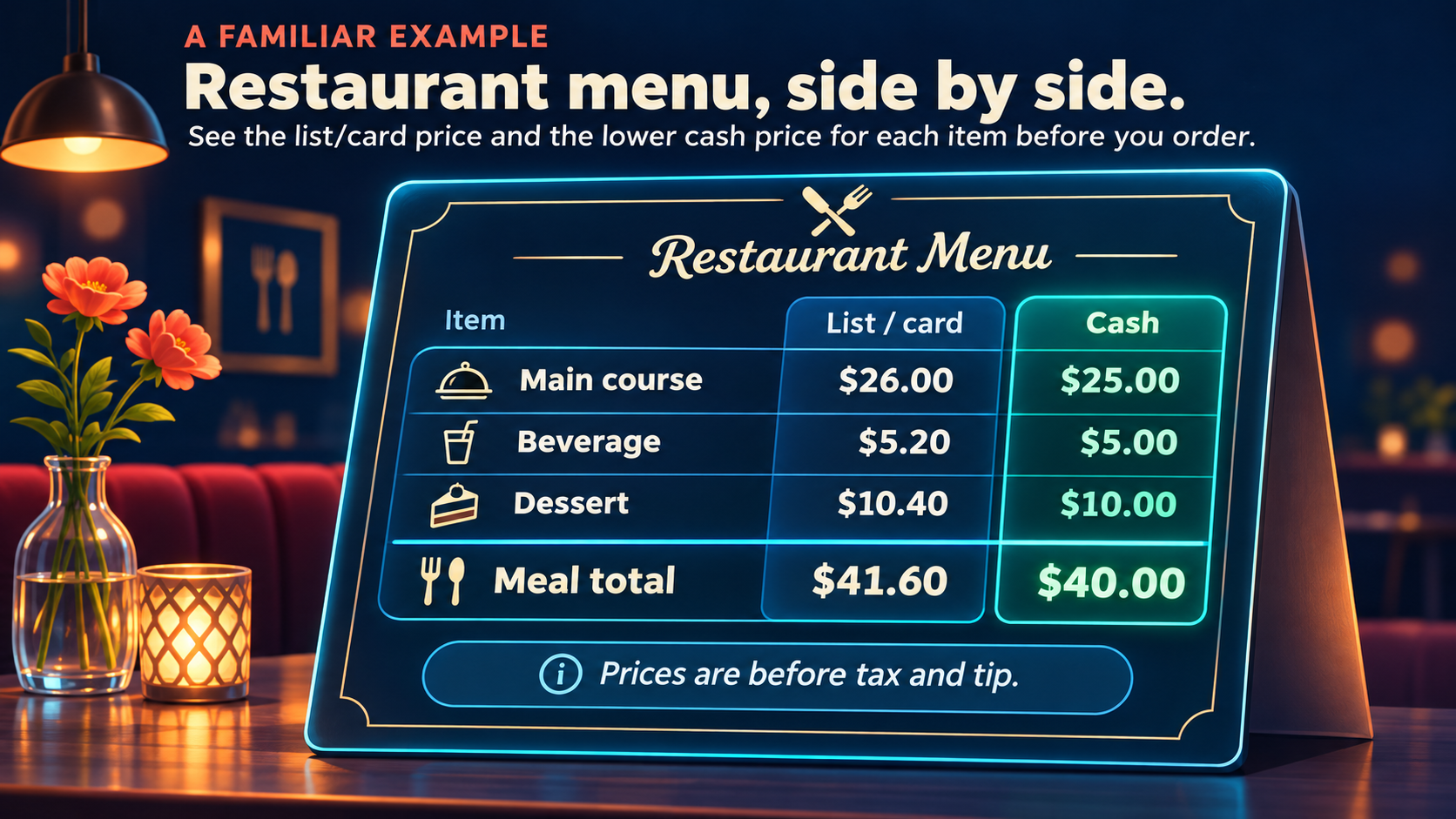
Imagine choosing dinner from a menu. The regular/list price is the higher amount; the cash price is a real discount. The customer can see the difference before deciding what to buy or how to pay—not discover an added card fee at the terminal.

Illustrated restaurant menu displaying side-by-side list/card prices and cash prices: Main course at $26.00 list vs $25.00 cash, Beverage at $5.20 vs $5.00, Dessert at $10.40 vs $10.00, Meal total $41.60 vs $40.00

Example menu • shown before ordering

Sample dinner (before tax and tip)

ItemList / cardCash
Main course$26.00$25.00
Beverage$5.20$5.00
Dessert$10.40$10.00
Meal total$41.60$40.00

Illustrative prices only. How taxes, tips, rounding and item disclosures work depends on the POS, the program and applicable rules.

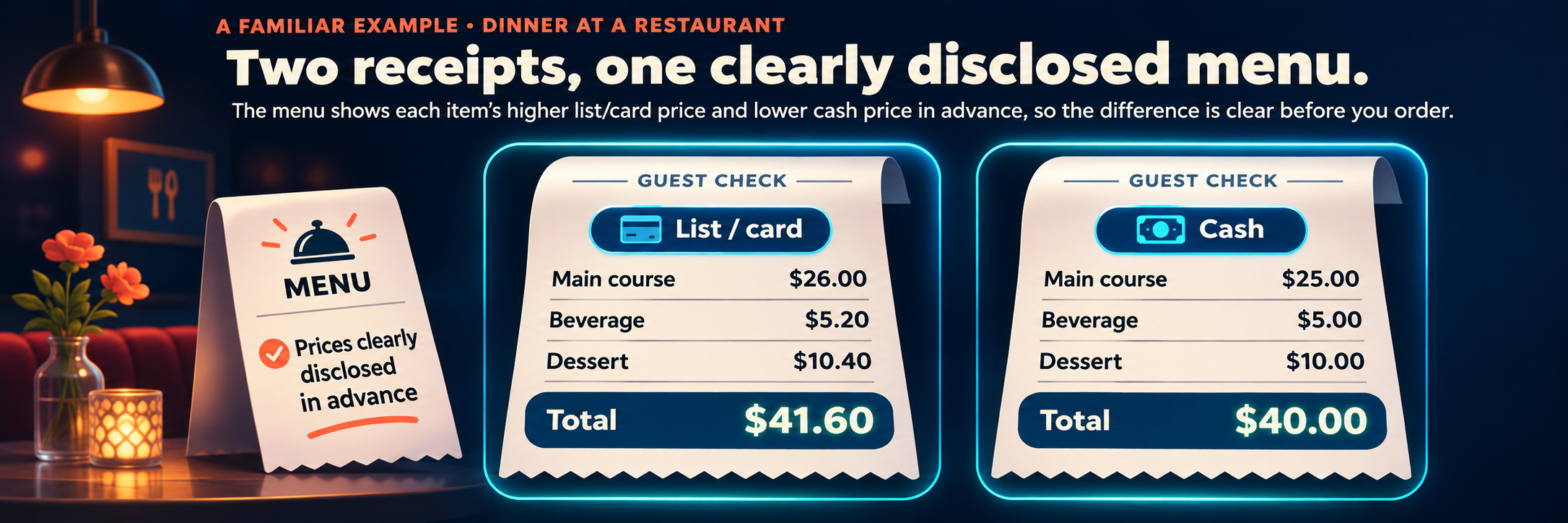
Two restaurant guest checks compared side by side under one clearly disclosed menu: List/card total of $41.60 versus Cash total of $40.00 with itemized pricing disclosed in advance

Clearly disclosed: the menu shows each item's higher regular price and lower cash price in advance.

Different behavior: advertise only $40, then surprise a debit-card guest with an extra $1.60 at checkout.

This visual teaches the concept; it does not approve a particular merchant's setup. Confirm card-brand requirements, processor configuration and state rules.

ELIGIBLE CREDIT CARDS ONLY

Surcharging

Add a disclosed charge to eligible credit-card transactions—not debit or prepaid.

Under Visa's U.S. rules a surcharge may not exceed the merchant's applicable cost of credit acceptance or 3%, whichever is lower. Other networks have their own rules, and state laws can impose further restrictions. Advance notices, disclosures and receipt requirements may also apply.

Visa debit and prepaid cards cannot be surcharged, even if the customer selects “credit” at the terminal. Your system must identify eligible cards accurately.

Why merchants consider it

May recover some eligible credit-card acceptance costs.

What to watch

Credit-versus-debit detection, caps, disclosures, card-brand requirements and state law demand careful setup.

START WITH THE REGULAR PRICE

Proper cash discounting

Post the true regular price first, then reduce it when the customer pays cash.

Regular / list price

$41.60

Cash price

$40.00

In the restaurant example, the posted $41.60 regular price is reduced to $40 for cash. That is different from advertising $40 and then adding a $1.60 “non-cash adjustment” at checkout. Giving an added card-dependent fee a discount-sounding name does not change how the transaction works.

Why merchants consider it

Clear cash incentive when the actual regular price and discount are displayed upfront.

What to watch

Some programs marketed as cash discounting actually behave like added card fees. Check signs, receipts and terminal behavior.

TWO REAL PRICES, DISPLAYED AHEAD OF TIME

Proper dual pricing

Display list/card and cash prices before payment, ideally on shelves or menus.

Regular / list price

$41.60

Cash price

$40.00

Think of the restaurant menu above: the higher list/card prices and lower cash prices are visible for the individual items before ordering. The guest knows the price difference ahead of time rather than finding a surprise line-item card fee when it is time to pay.

A POS capable of proper dual pricing can store or calculate the list price and cash price of each item. It can create itemized receipts from the applicable prices instead of inserting a generic fee on top of the cheaper items. A restaurant guest check can show both sets of item prices, or at least clearly identify both totals before tender, subject to applicable laws.

Why merchants consider it

Transparent payment choice, with item-level accounting and receipts on appropriately configured systems.

What to watch

Not every POS's “dual-pricing” feature truly supports two item prices. Check signage, menus, taxes, tips, refunds and local rules.

LESS COMMON; EXAMINE THE BEHAVIOR

Reverse cash discounting / general service fee

A fee applied to every tender differs from one that disappears for cash, but a name proves nothing.

“Reverse cash discount” is not a standardized network pricing model. Some offerings use the term for an administrative fee that applies to cash, credit and debit alike. If a fee disappears for cash, it may behave like a card-dependent charge regardless of its name.

Even a genuine all-tender fee is not automatically compliant. Mandatory fee disclosures, posted price rules and applicable law still matter.

Why merchants consider it

A truly uniform, clearly disclosed service fee is conceptually different from a card-only surcharge.

What to watch

Question why the fee exists, which customers pay it and whether total pricing is disclosed before purchase.

MAKE THE LESSON ENTERTAINING

The Discount That Wasn't: the $3.99 Mystery

Follow Delilah Discount, Scarlett Surcharge and Detective Pierce Price in our illustrated companion article—or check how your own setup behaves.

Educational overview only, not legal advice or compliance certification. Card-brand requirements and state laws vary; confirm current requirements before implementation.

MERCHANT EDUCATION • INTERACTIVE

Is Your Cash Discount Really a Discount?

A pricing program's name doesn't tell the whole story. See what happens when an added fee surprises a debit-card customer, then explore what your own setup actually does.

Delilah Discount presents her compliant payment solution to Marty at Riverside Antiques
INTERACTIVE STORY • STANDALONE CASE

Delilah's Discount Deception

The Case of the Disappearing Discount

Meet Delilah Discount, Detective Pierce Price, and the hidden identity revealed by his Truth Lens.

Read the story
Detective Pierce Price inspecting a processing receipt with the merchant
INTERACTIVE CHECK • MERCHANT SELF-ASSESSMENT

Fee Offset Reality Check

Answer questions about posted prices, cash and card treatment, Visa debit, added fees, and your agreement. Get an educational result with next steps.

Take the Reality Check

Educational content; this self-check is not legal advice or compliance certification. Browse Stories & Adventures.

THE PPT SOUTHEAST APPROACH

We Start With Your Business—not a Rate Sheet.

Two businesses processing the same monthly volume can have very different transaction mixes, technology needs and operating priorities.

Our job isn't to force every merchant into the same pricing model. We look at how you accept payments, what you're currently paying, the technology you need and what matters most to your operation. Then we help you compare the available options.

Understand your current effective processing cost
Review fees and pricing structure
Consider technology and operational needs
Compare the payment options that fit your business
THE COMPLETE PICTURE

The Cheapest Rate Isn't Always the Best Business Decision.

Payments don't operate in isolation. POS technology, software, integrations, customer experience, support and workflow can sometimes create far more value than a small difference in processing cost.

Sometimes the right answer is more competitive traditional pricing. Sometimes it is dual pricing. Sometimes better technology creates more value than shaving a few basis points from processing. That's why PPT Southeast looks at Technology, Payments, Growth and Support together—not simply one processing number.

Technology
Payments
Growth
Support
A DIFFERENT PAYMENT ECONOMY

What If Processing Could Pay You Back?

For qualifying businesses, Prime49 offers another approach that can go beyond simply reducing or offsetting eligible processing costs and create the opportunity for payments to contribute back to the business.

LET'S LOOK AT THE REAL COST

Let's Look at What You're Actually Paying.

Have a recent processing statement? We'll help you understand your current setup, identify what is actually driving your processing cost and compare the payment structures available for your business.